


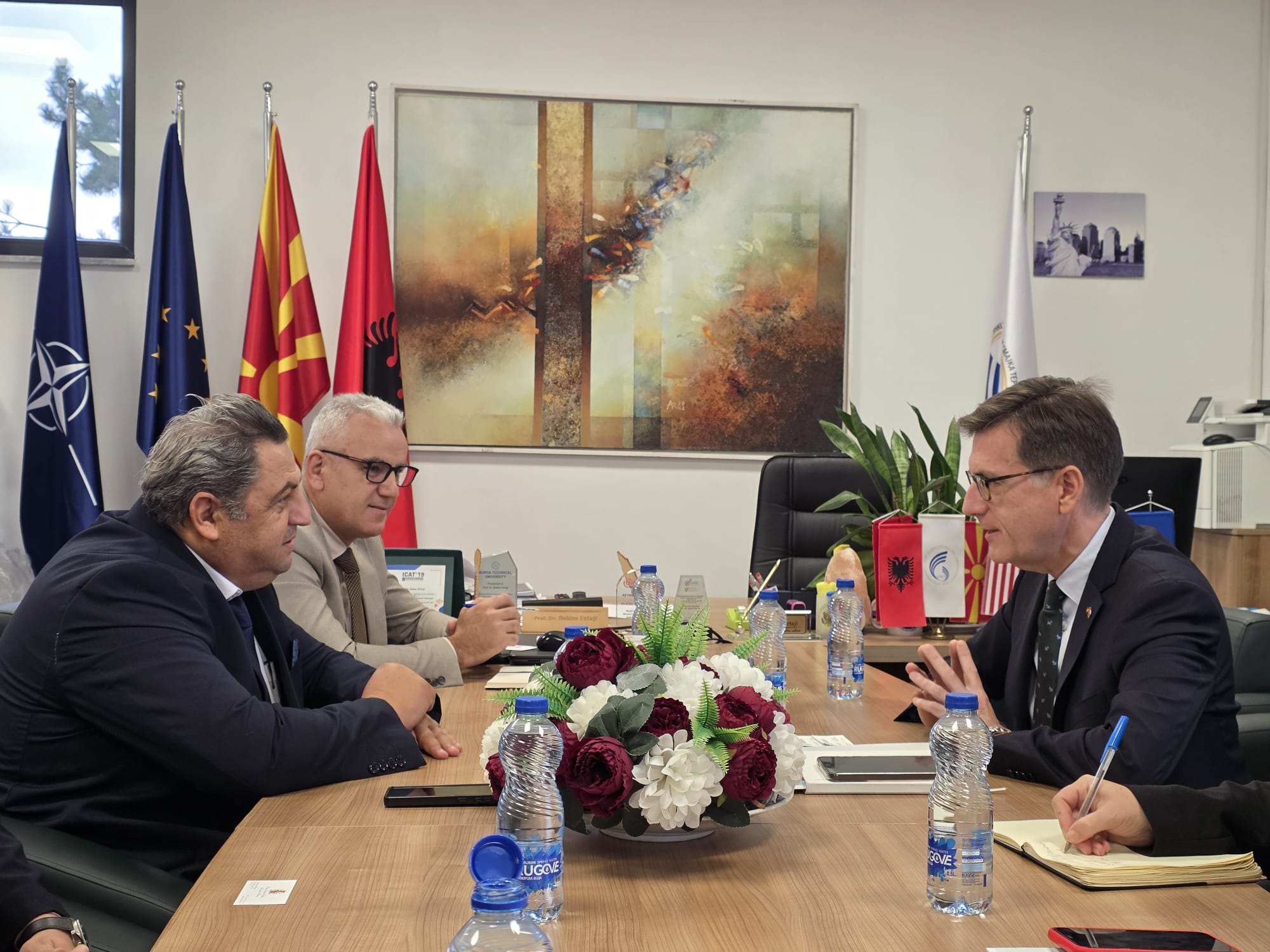
The Rector of Mother Teresa University in Skopje, Full Prof. Bekim Fetaji, Ph.D., welcomed the Spanish diplomat and highlighted the importance of academic cooperation and European integration for MTU students.
Skopje, October 26, 2026 – Today, in his office, the Rector of Mother Teresa University in Skopje, Full Prof. Bekim Fetaji, Ph.D., welcomed His Excellency Mr. Rafael Soriano Ortiz, Ambassador of the Kingdom of Spain to the Republic of North Macedonia, for an official visit and a working meeting.
At this important meeting, MTU Rector Full Prof. Bekim Fetaji, Ph.D., was accompanied by the Vice-Rector for Teaching, Full Prof. Fati Iseni, Ph.D.; the Vice-Rector for International Relations, Full Prof. Diturije Ismaili, Ph.D.; the Vice-Rector for Finance, Full Prof. Bujamin Bela, Ph.D.; and Ariton Rama, M.A., while H.E. Mr. Soriano Ortiz was accompanied by Ms. Venera Gudaci.
During the meeting, the participants discussed opportunities to deepen bilateral cooperation, exchange academic experiences, and explore the importance of European integration.
Following the official meeting, H.E. Mr. Rafael Soriano Ortiz delivered an open and informative lecture to MTU students and academic staff, dedicated to the commemoration of “40 Years of Spain in the European Union: 40 Indicators of Social Progress and Freedoms.”
During his presentation, the Ambassador used comparative statistical data to illustrate Spain’s profound transformation over four decades of EU membership, highlighting several key achievements: an increase in life expectancy to 84 years and the participation of more than one million students in the Erasmus programme in the area of human development; a doubling of exports and a leading position in renewable energy, accounting for 57% of the country’s energy mix; its position as the world’s second most visited country, with 97 million visitors, as well as its leading position in high-speed rail (AVE) infrastructure and UNESCO reserves in the area of connectivity; and significant progress in gender equality, democracy, and healthcare.
The lecture sparked considerable interest among both students and academic staff, who had the opportunity to engage directly in discussions and ask questions related to the challenges of European integration, higher education, and sustainable development.