


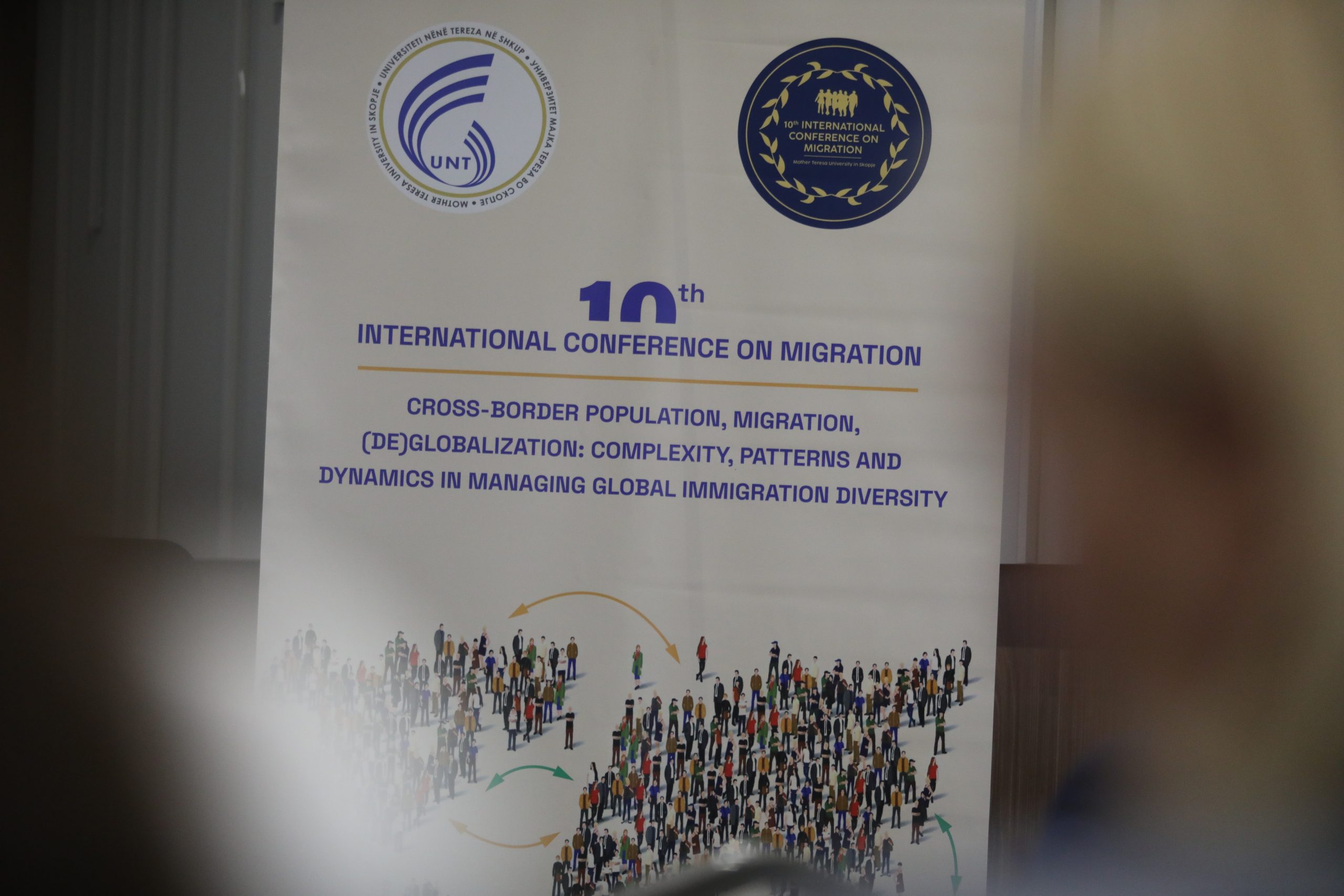
40+ scientific papers from around the world and high-level institutional representatives united at the plenary session
Skopje, May 21, 2026 – Today, Mother Teresa University, specifically the Faculty of Social Sciences, officially opened the 10th anniversary edition of the International Migration Conference. This important scientific event gathered distinguished researchers, high-level institutional representatives, and representatives of international organizations in the open hall of Actor Hotel and at the premises of MTU, with the aim of addressing the geopolitically significant topic: “Cross-Border Population, Migration, (De)Globalization: Complexity, Patterns, And Dynamics In Managing Global Immigration Diversity.” This year’s conference represents a major academic achievement for MTU, featuring 40+ accepted scientific papers from researchers and experts from the country, the region, and across the world, including prestigious institutions such as the Austrian Academy of Sciences and the University of Warwick. The event was successfully led and coordinated by the General Coordinator of the Conference, Assoc. Prof. Drenusha Kamberi, Ph.D.
The Rector of Mother Teresa University, Full Prof. Bekim Fetaji, Ph.D., in his opening remarks emphasized that this tenth anniversary transforms our university into a regional reference center for migration studies. He warned about demographic challenges:
“For our Western Balkan region, this discussion carries a double burden. We are facing the challenges of managing transit flows, while simultaneously suffering from the wounds of youth exodus, i.e., academically speaking, the so-called ‘brain drain.’ According to United Nations data, our region risks losing up to one-third of its young population by the end of the century provided that current trends continue. These figures are but an urgent call for action.”
The First Deputy Prime Minister, Mr. Bekim Sali, focused on legal reforms and the strategic framework, linking migration management with European integration, stating:
“For us, as a candidate country for EU membership, these issues are directly connected to Chapter 24 of the negotiations (justice, freedom, and security). The Migration Policy Resolution 2026–2030, the Strategy for the Integration of Refugees and Foreigners, and our observer membership in the European Union Migration Network, demonstrate our institutional commitment. During 2025, we recorded a 10.9% decrease in prevented attempts of illegal border crossings, and this remains a challenge that requires regional coordination.”
The representative of DCAF – Geneva Centre for Security Sector Governance, Mr. Vlado Gjerdovski, highlighted the importance of effective border governance based on the principles of the rule of law:
“From DCAF’s perspective, migration is not only a demographic or humanitarian issue, but is closely linked to governance, human rights, and accountability. No state can manage the complexity of migration flows by itself. Effective governance requires balanced policies that simultaneously protect national security and human dignity. Scientific analyses and empirical research are the main guidelines upon which long-term strategies should be built.”
The Vice Rector for Science, Assoc. Prof. Sani Demiri, Ph.D., emphasized international university cooperation as a bridge for addressing global crises:
“The hybrid dimension of this 10th edition and the inclusion of partners such as DCAF – Geneva Centre for Security Sector Governance, International Organization for Migration (IOM), Legis, and Uttara University demonstrate that science knows no geographical boundaries. This academic networking enables us to exchange the best scientific platforms to understand how deglobalization affects labor markets and cross-border movements, offering data-driven solutions for the protection of cultural diversity.”
The Dean of the Faculty of Social Sciences, Assoc. Prof. Bejtulla Emini, Ph.D., as host of the event, expressed gratitude to all generations who contributed to this 10-year journey:
“The fact that on this day we are organizing the tenth edition is but a clear proof of our academic commitment to creating spaces where the most vital issues of society are discussed. Our region faces challenges related to youth migration and labor mobility; therefore, universities play an important role in addressing these processes through scientific research and academic debate. As the Faculty of Social Sciences, we remain committed to creating academic spaces where the most current and significant societal topics are addressed.”
Following the plenary session at Actor Hotel, the conference continued throughout the day in four parallel scientific and hybrid sessions at the premises of Mother Teresa University in Skopje, concluding with concrete recommendations for regional and global migration policymaking.