


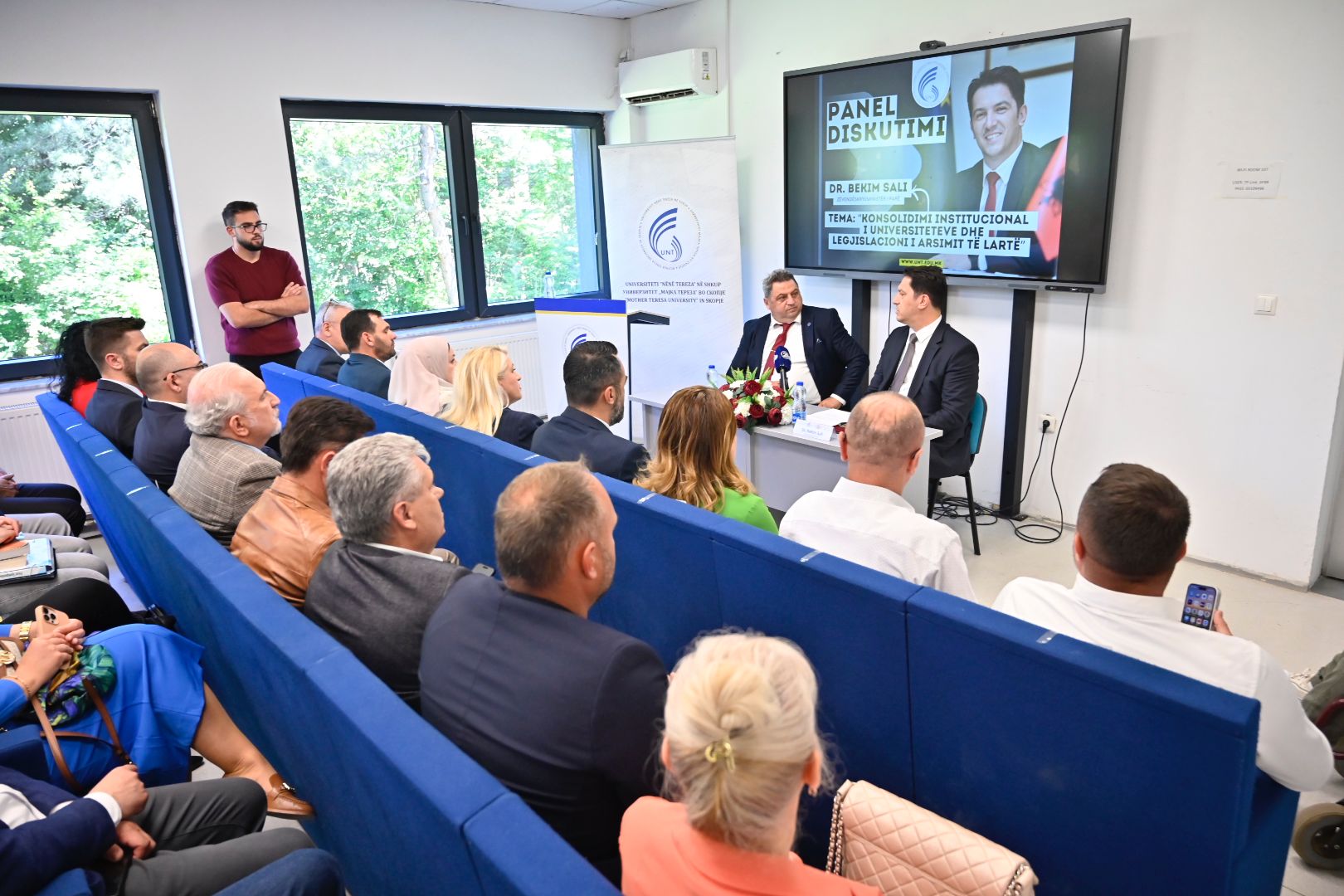
Skopje, May 14, 2026 – Today, Mother Teresa University in Skopje organized a panel discussion on the subject of “Institutional Consolidation and Higher Education,” featuring the special guest, the First Deputy Prime Minister of Republic of North Macedonia and Minister for European Affairs, Mr. Bekim Sali, Ph.D. The event, led by the Rector of MTU, Full Prof. Bekim Fetaji, Ph.D., brought together academic staff, students, and senior representatives of the executive branch.
The panel discussion was opened by the Rector of Mother Teresa University, Full Prof. Bekim Fetaji, Ph.D., who, in his introductory remarks, emphasized that this very event represents a key moment for reflecting on the university’s development to date. He stressed that institutional consolidation is not merely an administrative process, but a shared mission aimed at ensuring legal sustainability and academic quality. Rector Full Prof. Bekim Fetaji, Ph.D., highlighted that close cooperation with representatives of the executive branch, such as today’s presence of Deputy Prime Minister Sali, is but an evidence of the willingness to align the academic vision with legislative reforms, with the goal of ensuring that MTU remains a modern institution with full autonomy and adequate infrastructure for scientific research.
In his keynote address, Mr. Bekim Sali, Ph.D., focused on key issues concerning the functioning of higher education in the country. He elaborated on the role of state, economic, and social strategic policies in supporting the development and institutional consolidation of universities, viewing them as pillars of social progress. Particular attention was given to reforms in higher education legislation, especially the significance of the Statute as the fundamental document defining the organizational structure of the university. Mr. Sali also emphasized the urgent need for alignment between state policies, investments in educational and scientific research infrastructure, and the preservation of university autonomy as a prerequisite for academic freedom and quality.
During the Q&A and discussion session, attendees also had the opportunity to hear specific information from advisor Mr. Sahmedin Sali, who addressed the latest legislative initiatives. He informed the academic staff and the students about the progress of the amendments to the new Higher Education Law, which is currently in a procedural phase within the Government. Mr. Sali explained that these amendments aim to address the current needs of universities by optimizing the legal framework for more flexible operation and alignment with European standards, which generated increased interest among participants regarding the practical impact of the reforms.
The panel continued with a substantive and interactive debate, in which students and academic staff contributed opinions and raised specific questions regarding the challenges posed by the current legislation.
At the conclusion of the event, MTU Rector Full Prof. Bekim Fetaji, Ph.D., on behalf of the academic community, presented Mr. Sali with a Plaque of Appreciation, with the following dedication:
“For the exceptional contribution, tireless commitment, and selfless support in the process of institutional and legal consolidation of Mother Teresa University in Skopje. This recognition expresses the high respect of the academic community and students for your key role in advancing higher education and strengthening the status of our university.”
In addition to students and academic staff, the panel discussion was attended by senior state officials and experts from the field of education, who contributed to the professional character of this academic event, i.e., Member of Parliament Ms. Imerlije Saliu, Deputy Minister of Education and Science Mr. Driton Sulejmani, Director of the State Education Inspectorate Mr. Shaban Allajbegu, Director of the Center for Vocational Education Development Mr. Besnik Zendeli, and Deputy Director of the State Examination Center Mr. Bujamin Kadriu. The panel discussion was further enriched by the presence and expertise of advisors Mr. Sahmedin Sali and Mr. Afan Elezi.